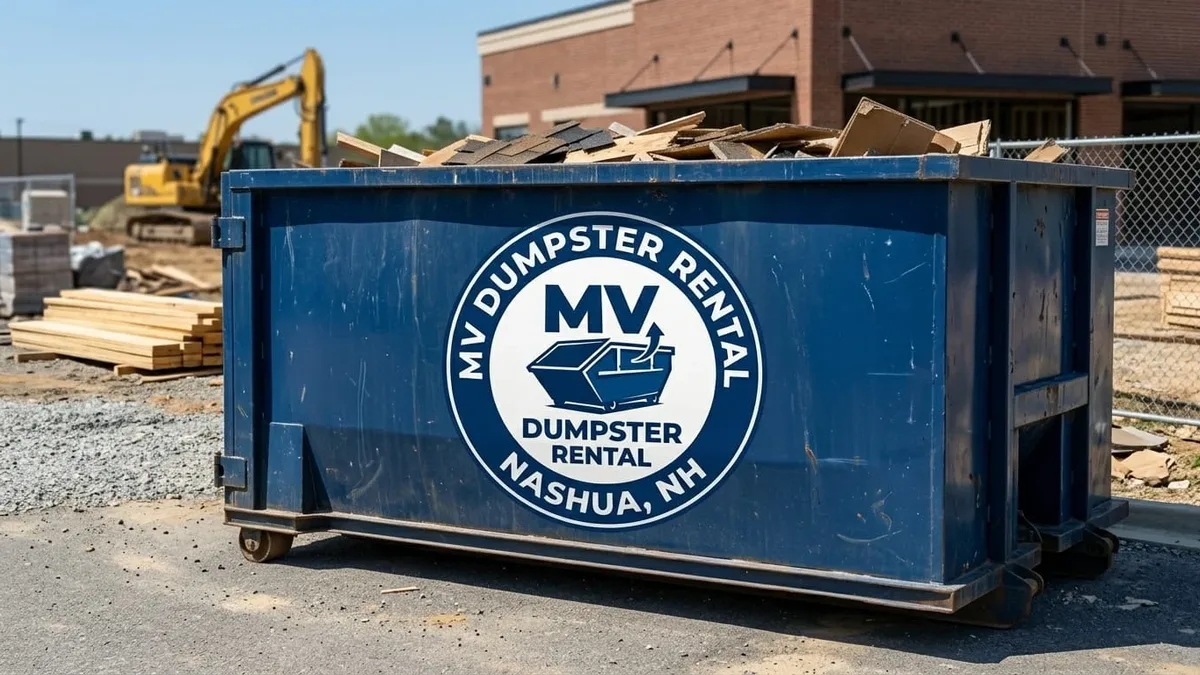
Permit questions come up often enough that it’s worth laying out plainly, because the answer genuinely depends on where the container is going — not just which town you’re in. Here’s how it breaks down across Nashua and the 13 towns we serve in New Hampshire and Massachusetts.
Private Property: No Permit, Ever
If a dumpster sits entirely on private property — your driveway, yard, gravel pad, or a jobsite lot you own or are working on — no permit is required anywhere in our service area, full stop. This covers the large majority of the deliveries we make, whether it’s a residential clean-out in a Nashua neighborhood or a construction project out in one of the surrounding towns. If you’ve got room on your own property for the container, that’s the end of the permit question.
Street or Right-of-Way Placement Inside Nashua City Limits
Once a container needs to sit in the street or public right-of-way — because a driveway’s too tight, too short, or unavailable during the rental — that’s a different situation inside Nashua city limits specifically. The City of Nashua’s own Board of Public Works handles this, under City Code Chapter 285 (Streets & Sidewalks), obstruction-license section. The only dollar figure published anywhere in that chapter of the City’s own code is a $300 fee — but that fee is scoped specifically to moving structures through city streets, not to dumpster placement. We won’t attach that figure to a dumpster permit, and you shouldn’t either: call the Board of Public Works directly to confirm current requirements and any applicable fee before you plan on right-of-way placement. We’re also glad to help you think through whether right-of-way placement is even necessary for your project — sometimes a different size or a bit of driveway rearranging avoids the question entirely.
Other New Hampshire Towns in Our Service Area
Hudson, Merrimack, Milford, Amherst, Hollis, Brookline, Pelham, and Litchfield are all in Hillsborough County alongside Nashua, and Londonderry and Windham are in Rockingham County — but neither county has any land-use or right-of-way permitting authority at all in New Hampshire. Each of these towns handles its own street or right-of-way placement through that town’s own select board or public works department, never through a county office. Don’t assume Nashua’s Board of Public Works process applies in any of these towns — if your project needs right-of-way placement outside Nashua, check with that town directly. See our service area page for the full list of towns we cover.
The Massachusetts Towns: Tyngsborough, Dunstable, and Pepperell
The same pattern holds across the state line in Tyngsborough, Dunstable, and Pepperell — each town’s own select board or public works department handles street or right-of-way permitting, not a county office. The one genuine difference is that Massachusetts is its own state with its own state-level environmental agency, MassDEP, rather than New Hampshire’s NHDES. That distinction matters more for disposal rules than for permitting itself, but it’s worth knowing you’re dealing with a different state government once you cross into these towns. Check with the specific town’s office to confirm its process.
Why New Hampshire Is Structured This Way
It helps to understand the basic structure behind all of this: New Hampshire has no township layer separate from its incorporated towns, and no unincorporated land at all in this part of the state — every acre sits inside some town or city’s own boundary. That’s exactly why there’s no county fallback the way some other states have; Hillsborough and Rockingham counties simply don’t have a permitting role to fall back to. Once you know which town your project sits in, you know which office to call — Nashua’s Board of Public Works for in-city placement, or that town’s own select board or public works department everywhere else.
Why This Is Worth Sorting Out Before Delivery Day
Permit timing matters more than most people expect. A town office can take time to process a request, and that’s time you don’t want to lose once a container is scheduled and a project is already underway. If there’s any chance your driveway won’t accommodate the size you need — a longer container on a shorter lot, or a job where the driveway itself is part of the work — it’s worth raising that when you first call for a quote rather than the morning of delivery. We can often talk through options at that stage, including whether a different size fits the space you actually have, before a right-of-way permit even becomes necessary. Our dumpster rental cost guide also touches on how placement can factor into scheduling.
When You’re Not Sure Which Applies
If you’re not sure whether your project needs a permit at all, the simplest fix is usually to plan for private-property placement in the first place — it sidesteps the permit question entirely and is how most of our deliveries work. If right-of-way placement genuinely is the only option, tell us your address and town when you call and we can help point you toward the right office, whether that’s Nashua’s Board of Public Works or another town’s permitting desk. Call MV Dumpster Rental Nashua at (603) 704-3257, or reach out through our contact page with details about your project and location.